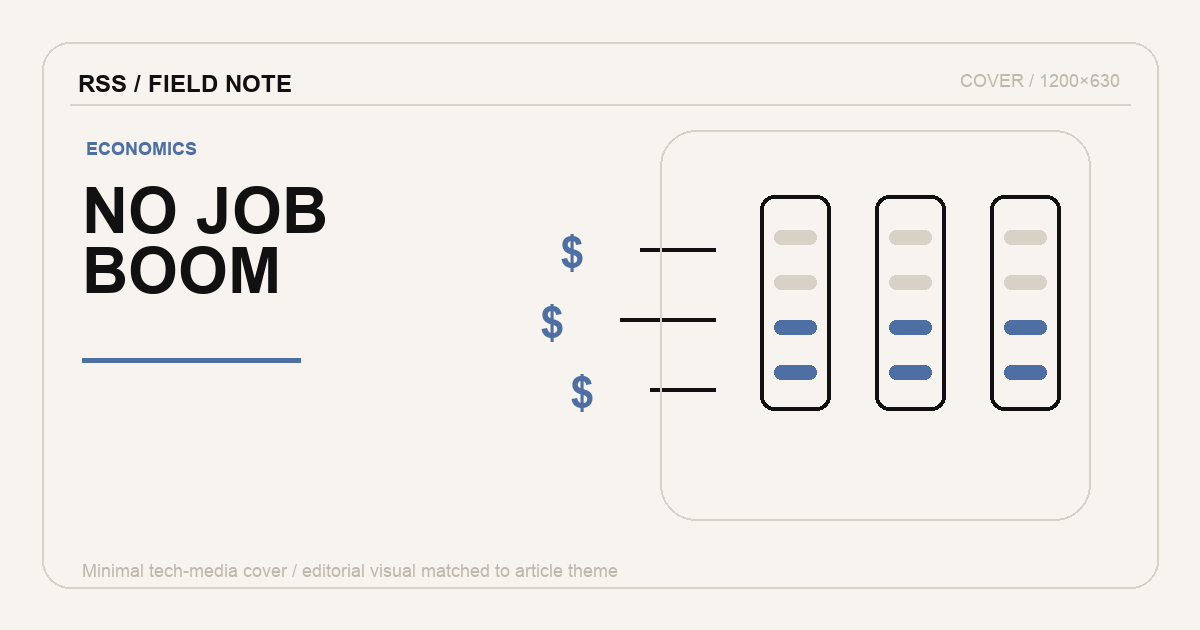
This is the part of the AI boom that keeps bothering me: the money is everywhere, but the hiring wave is not. The valuations are huge. The compute budgets are huge. The cloud bills are huge. The data center spending is huge. And still, when you look at the labor market, you do not see the same outward job explosion that older tech booms created.
That mismatch stops looking mysterious once you look at where the money actually lands. In older internet and mobile booms, capital spilled outward into people: product managers, marketers, support teams, QA, operations staff, content workers, contractors, creators, drivers, couriers, moderators, junior developers. In this boom, a brutal amount of the money goes somewhere else first: chips, compute, cloud contracts, data centers, power, and very small high-leverage teams. That is why the AI boom can feel enormous on paper and stingy in real life.
The Difference Starts With a Very Concrete Budget Question
In the old playbook, a fast-growing digital company usually translated money into headcount.
New product? Hire a team.
More users? Hire support.
More features? Hire developers, QA, designers, ops.
More growth? Hire marketing and sales.
That is why earlier waves absorbed so many workers. The software needed a lot of humans around it.
AI money behaves differently.
A lot of the new budget does not say, "hire more people."
It says:
- reserve compute
- buy chips
- lock in cloud capacity
- pay for inference
- scale the data center
That is a completely different labor story.
The Old Booms Hired Crowds. This One Buys Infrastructure
This is the simplest way I can put it.
The web boom hired crowds.
The mobile boom hired crowds.
The AI boom buys infrastructure first.
That matters because infrastructure does not hire like a consumer platform hires.
A giant compute contract does not create the same ripple effect as a marketplace, delivery network, or ad-driven consumer app scaling through human coordination.
The spending is real. The economic activity is real. But the employment multiplier is much weaker.
Small Teams Can Now Build What Used to Need Departments
This is the second piece people keep underestimating.
A lot of AI products are built on top of:
- existing model APIs
- existing cloud infrastructure
- existing interface patterns
- AI-assisted coding workflows
That means one sharp engineer or one small senior-heavy team can now push through a shocking amount of work that used to be spread across multiple roles.
You can hear it in the meeting logic:
not "we need five more people,"
but "let's see how far the current team gets with better tools."
That one sentence explains a lot of the missing jobs.
This Boom Was Built to Need Fewer People
This is the sentence people keep trying to avoid because it sounds too blunt.
AI is not just a new sector.
It is an efficiency layer being dropped on top of existing sectors.
And when an efficiency layer works, companies do not mainly ask, "Who else should we hire?"
They ask:
- what can we automate?
- which team can stay smaller?
- which role can we stop backfilling?
- which junior tasks no longer justify a salary?
That is not a weird side effect of the boom.
That is the business case.
The Jobs That Are Growing Are Real, but Narrow
This does not mean no jobs are being created.
They are.
But look closely at what kind of jobs they are:
- model research
- infrastructure engineering
- evaluation
- AI product work
- enterprise implementation
- governance and risk
- solutions and integration
Those jobs matter.
Some pay very well.
But they are not broad "come in and learn on the job" categories. They are narrower, more specialized, and smaller in total volume than the mass employment layers older tech waves created.
That is why the market feels upside-down. There is real opportunity, but not the kind that comfortably absorbs everybody trying to enter.
The Junior Layer Gets Hit First
This is where the problem starts feeling personal.
In older teams, a lot of entry-level work existed because somebody had to do the repetitive stuff:
- documentation cleanup
- basic CRUD work
- QA passes
- first-draft copy
- spreadsheet wrangling
- routine research
- repetitive design production
That layer was not glamorous, but it gave people a way in.
AI is eating exactly that layer first.
So even when the profession survives, the ladder into the profession can still collapse.
That is one reason this boom feels so cold. It is not only changing jobs. It is changing who still gets a shot at learning them.
The One Hopeful Part Is Not "More Jobs." It Is "Cheaper Leverage."
If I am trying to be honest and still find the opening here, it is probably this:
AI may lower the cost of building a very small business, a solo operation, or a tiny high-output team.
That matters.
A consultant can do more.
A solo founder can ship faster.
A niche shop can stay small and still get work done.
A subject-matter expert can productize knowledge without hiring a full operation.
That is real leverage.
But notice what kind of hope this is. It is not a mass-hiring story. It is a small-team leverage story.
That is much narrower.
Final Thought
So why is the AI boom not creating jobs the way past tech booms did?
Because this time the money is not mainly building giant human layers around new platforms.
It is buying compute, compressing teams, and teaching companies that fewer people can produce enough.
That is why the boom looks huge from the top and thin from the ground.
The capital is real.
The technology is real.
The productivity story is real.
And a big part of the value proposition is still the same ugly sentence people keep trying not to say out loud:
the system is supposed to need fewer people.